One man's slight obsession with obsolete computer hardware.
Commodore 64 Speed Loaders: Load Bytes per Second
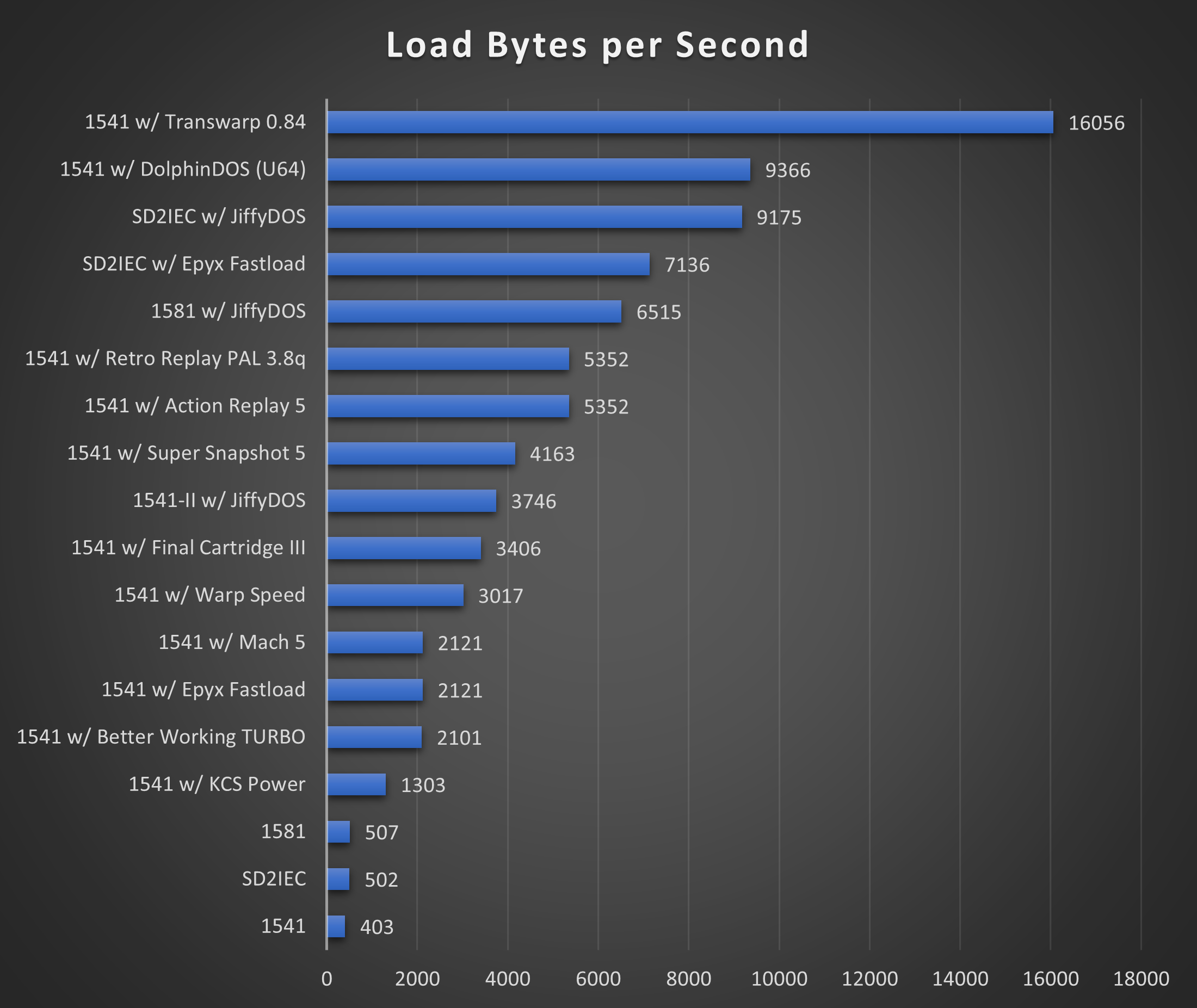
Load Bytes per Second comparison, EXCLUDING U64 Hyperspeed.
11 thoughts on “Commodore 64 Speed Loaders: Load Bytes per Second”
Knutbert Feinbein-Klotz
SD2IEC with FC3 would also have been interesting, this is, how i have it in everyday use here, when i utilize my SD2IEC.
I guess, the speed will be somewhere between JiffyDOS+SD2IEC and EpyxFastload+SD2IEC. It’s interesting how much faster the SD2IEC-compatible modul-fastloaders are, compared to the speed, they have, when a 1541-floppy is in use.
Software-fastloaders like “Transwarp” are impressive, the speed they bring. Not ideal i find, that a disk must be prepared before, that this loader then can be used, it can not only be put as a file on the disk, then loaded and then works like other software-emulators. But therefore, “Transwarp” is a faster than the others, seems like you can’t have everything *lol*.
By the way, another interesting software-fastloader is “Mafiosino Trackloader”, which has around 20x speed and can load a 200 Block file in around 5 seconds, which is similar to the “Dolphin-DOS” speeder-kernel. And if we are already writing about speeder-kernels, then “Prof-DOS” must also be mentioned, which is even faster than “Dolphin-DOS” and is probably comparable to “Transwarp”, in terms of speed.
I wrote my own fast loader in the mid 80s, it loads 182 blocks in about 5 sec or less depending on initial seek time.
It can also write at the same rate but I never bothered to finish writing code to handle the checksums on the sector data. I called it Nitrox and also started working on backup program it can read an entire disk in about 22s. I posted all the details on c128.com quite a few years ago.
Sounds interesting Craig. Can you upload an executable version of your Nitrox fastloader somewhere on the internet? I am sure, it would be interesting for alot of people.
Craig, if you had found your Nitrox loader, then you could link it here, then somebody (I can do it for example) can upload it to the CSDB and other interested C64 users could then also use your loader. I think, this would be an interesting thing. Would be a sad, if this Nitrox ended up, sitting on some old disks somewhere, only for the disk to fail eventually and the loader to be lost finally. So if you found it, upload it and give a link here. Regards
Three and a half years from your first post about this alleged Nitrox fastloader until now, Craig and nothing happened. Where’s the problem, to upload a little fastloader and give a link to it? This takes maybe five minutes, no more.
But I think, this whole story about Nitrox is only a fairytale and completely made up. Nobody ever heard of this fastloader in the C64 scene and this scene is big.
One thing, that should also be mentioned, is the following. Yes it’s true, that Transwarp is theoretically the fastest of all these fastloaders. However, one must not forget the fact that, after loading a file, Transwarp always requires an extra second or two, to this file, for depacking/converting back. Apparently, because the files had to be converted into a special format beforehand, for this loader and converted back, at the end of loading. When you time now, how long it takes for a loaded game, to actually start, I discovered, by using a stopwatch, that Transwarp is actually slightly slower overall than loaders like Prof-DOS, Dolphin-DOS, or Mafiosino-DOS, since those don’t require any decompression after loading and also no special format.
So, while Transwarp loads a file the fastest, it doesn’t start this file the fastest, even if the depack time is fast, but in a comparison of all these ultrafast loaders, sometimes even one or two seconds can make the difference and that’s the case here. This converting/depacking time is a detail, that’s strangly never mentioned so far, on all these websites comparing C64 fastloaders. They only focus solely on raw data-throughput and here Transwarp is the best, but the brief decompression/converting time Transwarp needs is never listed.
Don’t get me wrong, I’m not trying to badmouth Transwarp, it’s a great fastloader, but the full picture includes, that it requires this little extra-time. Personally, I’m also put off by the fact, that files always must be converted into a special format beforehand, which unfortunately makes them significantly larger. If you have an old C64 game-collection on real disks, where all disk-sides were packed as full as possible (just the way everyone did it back then, for cost-reasons), you’ll sadly find out, that you can’t simply convert all those full disk-sides into Transwarp format, because after converting, not all files will fit to the disk-side. Then the whole process of copying individual files onto other disks begins, which is annoying. Therefore, that’s a major downside of this loader, for me personally.
Interesting website and thread. I timed the whole process manually, with a stopwatch, using various combinations of loaders, speeder kernels and hardware, to identify the fastest variants/combinations. These are the results, when loading a 200-block file from a floppy-disk (standard loading-time for a file of this size is around 130 seconds, when I time it with the stopwatch)
——————————————————————————————————————–
Prof-DOS Kernel on real floppy 4,5 sec. (28,9 x) (1.place)
——————————————————————————————————————–
Dolphin-DOS Kernel on real floppy 6,0 sec. (21,7 x) (2.place)
——————————————————————————————————————–
Mafiosino Loader on real floppy 6,5 sec. (20,0 x) (3.place shared)
——————————————————————————————————————–
SJ-LOAD on SD2IEC-Hardware 6,5 sec. (20,0 x) (3.place shared)
——————————————————————————————————————–
Transwarp-File on real floppy 7,0 sec. (18,6 x) (4.place)
(if a file also had exactly 200 blocks)
——————————————————————————————————————–
FC3-Cartridge on SD2IEC-Hardware 8,0 sec. (16,3 x) (5.place shared)
——————————————————————————————————————–
Transwarp-File on real floppy 8,0 sec. (16,3 x) (5.place shared)
(same file, which had 227 blocks then,
when converted to transwarp-format)
——————————————————————————————————————–
It’s true, what Eckbert had written, about the converting-time of transwarped files. That prevents Transwarp from being the fastest overall, but it still has to be factored in, because it delays the start of a file and that is what matters, in the end, how long it takes until a file finally starts.
Measurements were taken up to the point where the word “run” appeared on the BASIC screen. Although it takes a few more seconds (around 3 or 4) for a game (or program), to actually start, that delay depends on the specific game (e.g., whether it is packed or not). Since this has nothing to do with the raw loading-time itself, that interval was naturally excluded from the measurements. However, as I already mentioned, the brief conversion time required for Transwarp files to unpack (or rather to convert back to their original format) was included, as it is part of the whole process.
As the results show, the times were very close ultimately and even the slowest entries in the list, clocking in at 8 seconds, are incredibly fast, when you consider that loading a 200-block file from disk normally takes around 2 minutes and 10 seconds (130 seconds). In this sense, everyone is a winner here. All these loading-speeds are even significantly faster, than those achieved by older fastloaders that everybody used in the 80’s (Fastdisk, Hypraload, etc.). By the way, Jiffy-DOS is also very fast, when loading from an SD2IEC device, but sadly I was unable to stop the seconds here, due to the lack of that specific kernel, and SD2IEC loading-performances cannot be accurately emulated, because if this would have been possible, I would have used an emulator for this.
All these superquick fastloaders are very impressive. One really wishes, such fast loading capabilities had existed back in the mid of the 80’s. We were lucky, that things like fastload or hypraload exists, but these need around 30 to 40 seconds for a 200 blocks onefiler from disk. But also this was great, back then. I still remember, how much the C64 experience improved for me, when I got my first “Final Cartridge 3” cartridge in the year 1987. It felt like paradise and the handling was alot better with all these function-key commands and a fastloader, that was always active and don’t need to be loaded in before. That was fantastic back then.
But these fastloaders featured here, like for example the ones, Tony timed with a stopwatch, are even more than twice as fast, as the FC3 fastloader. Of these six loaders listed, the results of the Mafiosino loader impressed me the mos, because all the others are either speeder-kernels (Dolphin-DOS and Prof-DOS) or they require a special fileformat (Transwarp) or they load from an SD2IEC device, instead of a real drive. But the Mafiosino Loader does none of that. It’s a normal software fastloader, that loads directly from standard drives and the files don’t need to be converted either, which is really great. That said, I think all six listed loaders/combinations are excellent, because of their ultrahigh speed and good compatibility. When it comes to compatibility, especially the two speeder-kernels does a great job, because they also accelerate many in-game loading processes (reloading), something the other loaders generally don’t do.
The C64 floppy-drives was slow, back then, compared to the drives of some other 8-bit computers. But they are fast now, when using these highly-optimized tools with it. And that’s the greatest thing on the C64, it always offered great opportunities for optimization, allowing you to squeeze an incredible amount out of it, whether in terms of graphics, music, disk drives, and so on. That’s why it remains so popular today and why some modern demos and games actually look and sound, as though they were running on a 16-bit system.
Those are interesting results, Tony. Particularly surprised, I was especially by the Mafiosino Loader here, as it is neither a speeder-kernel (like ProfDOS or DolphinDOS) nor does it require a special file-format (like Transwarp) or run on specific hardware (like SJLoad on the SD2IEC). Yet, in terms of speed, it fully keeps pace, which is truly amazing. I had never heard of this fastloader before, but now I will test it out, for sure.
Cheers,
Uri
SD2IEC with FC3 would also have been interesting, this is, how i have it in everyday use here, when i utilize my SD2IEC.
I guess, the speed will be somewhere between JiffyDOS+SD2IEC and EpyxFastload+SD2IEC. It’s interesting how much faster the SD2IEC-compatible modul-fastloaders are, compared to the speed, they have, when a 1541-floppy is in use.
Software-fastloaders like “Transwarp” are impressive, the speed they bring. Not ideal i find, that a disk must be prepared before, that this loader then can be used, it can not only be put as a file on the disk, then loaded and then works like other software-emulators. But therefore, “Transwarp” is a faster than the others, seems like you can’t have everything *lol*.
By the way, another interesting software-fastloader is “Mafiosino Trackloader”, which has around 20x speed and can load a 200 Block file in around 5 seconds, which is similar to the “Dolphin-DOS” speeder-kernel. And if we are already writing about speeder-kernels, then “Prof-DOS” must also be mentioned, which is even faster than “Dolphin-DOS” and is probably comparable to “Transwarp”, in terms of speed.
I wrote my own fast loader in the mid 80s, it loads 182 blocks in about 5 sec or less depending on initial seek time.
It can also write at the same rate but I never bothered to finish writing code to handle the checksums on the sector data. I called it Nitrox and also started working on backup program it can read an entire disk in about 22s. I posted all the details on c128.com quite a few years ago.
Sounds interesting Craig. Can you upload an executable version of your Nitrox fastloader somewhere on the internet? I am sure, it would be interesting for alot of people.
Can you upload your loader somewhere on the internet, Craig, so that other people can also use it? Or was it just a joke from you?
Sure I’ll post a link to it here once uploaded. It will be a while as I’m moving house once again.
Craig, if you had found your Nitrox loader, then you could link it here, then somebody (I can do it for example) can upload it to the CSDB and other interested C64 users could then also use your loader. I think, this would be an interesting thing. Would be a sad, if this Nitrox ended up, sitting on some old disks somewhere, only for the disk to fail eventually and the loader to be lost finally. So if you found it, upload it and give a link here. Regards
Three and a half years from your first post about this alleged Nitrox fastloader until now, Craig and nothing happened. Where’s the problem, to upload a little fastloader and give a link to it? This takes maybe five minutes, no more.
But I think, this whole story about Nitrox is only a fairytale and completely made up. Nobody ever heard of this fastloader in the C64 scene and this scene is big.
One thing, that should also be mentioned, is the following. Yes it’s true, that Transwarp is theoretically the fastest of all these fastloaders. However, one must not forget the fact that, after loading a file, Transwarp always requires an extra second or two, to this file, for depacking/converting back. Apparently, because the files had to be converted into a special format beforehand, for this loader and converted back, at the end of loading. When you time now, how long it takes for a loaded game, to actually start, I discovered, by using a stopwatch, that Transwarp is actually slightly slower overall than loaders like Prof-DOS, Dolphin-DOS, or Mafiosino-DOS, since those don’t require any decompression after loading and also no special format.
So, while Transwarp loads a file the fastest, it doesn’t start this file the fastest, even if the depack time is fast, but in a comparison of all these ultrafast loaders, sometimes even one or two seconds can make the difference and that’s the case here. This converting/depacking time is a detail, that’s strangly never mentioned so far, on all these websites comparing C64 fastloaders. They only focus solely on raw data-throughput and here Transwarp is the best, but the brief decompression/converting time Transwarp needs is never listed.
Don’t get me wrong, I’m not trying to badmouth Transwarp, it’s a great fastloader, but the full picture includes, that it requires this little extra-time. Personally, I’m also put off by the fact, that files always must be converted into a special format beforehand, which unfortunately makes them significantly larger. If you have an old C64 game-collection on real disks, where all disk-sides were packed as full as possible (just the way everyone did it back then, for cost-reasons), you’ll sadly find out, that you can’t simply convert all those full disk-sides into Transwarp format, because after converting, not all files will fit to the disk-side. Then the whole process of copying individual files onto other disks begins, which is annoying. Therefore, that’s a major downside of this loader, for me personally.
Interesting website and thread. I timed the whole process manually, with a stopwatch, using various combinations of loaders, speeder kernels and hardware, to identify the fastest variants/combinations. These are the results, when loading a 200-block file from a floppy-disk (standard loading-time for a file of this size is around 130 seconds, when I time it with the stopwatch)
——————————————————————————————————————–
Prof-DOS Kernel on real floppy 4,5 sec. (28,9 x) (1.place)
——————————————————————————————————————–
Dolphin-DOS Kernel on real floppy 6,0 sec. (21,7 x) (2.place)
——————————————————————————————————————–
Mafiosino Loader on real floppy 6,5 sec. (20,0 x) (3.place shared)
——————————————————————————————————————–
SJ-LOAD on SD2IEC-Hardware 6,5 sec. (20,0 x) (3.place shared)
——————————————————————————————————————–
Transwarp-File on real floppy 7,0 sec. (18,6 x) (4.place)
(if a file also had exactly 200 blocks)
——————————————————————————————————————–
FC3-Cartridge on SD2IEC-Hardware 8,0 sec. (16,3 x) (5.place shared)
——————————————————————————————————————–
Transwarp-File on real floppy 8,0 sec. (16,3 x) (5.place shared)
(same file, which had 227 blocks then,
when converted to transwarp-format)
——————————————————————————————————————–
It’s true, what Eckbert had written, about the converting-time of transwarped files. That prevents Transwarp from being the fastest overall, but it still has to be factored in, because it delays the start of a file and that is what matters, in the end, how long it takes until a file finally starts.
Measurements were taken up to the point where the word “run” appeared on the BASIC screen. Although it takes a few more seconds (around 3 or 4) for a game (or program), to actually start, that delay depends on the specific game (e.g., whether it is packed or not). Since this has nothing to do with the raw loading-time itself, that interval was naturally excluded from the measurements. However, as I already mentioned, the brief conversion time required for Transwarp files to unpack (or rather to convert back to their original format) was included, as it is part of the whole process.
As the results show, the times were very close ultimately and even the slowest entries in the list, clocking in at 8 seconds, are incredibly fast, when you consider that loading a 200-block file from disk normally takes around 2 minutes and 10 seconds (130 seconds). In this sense, everyone is a winner here. All these loading-speeds are even significantly faster, than those achieved by older fastloaders that everybody used in the 80’s (Fastdisk, Hypraload, etc.). By the way, Jiffy-DOS is also very fast, when loading from an SD2IEC device, but sadly I was unable to stop the seconds here, due to the lack of that specific kernel, and SD2IEC loading-performances cannot be accurately emulated, because if this would have been possible, I would have used an emulator for this.
All these superquick fastloaders are very impressive. One really wishes, such fast loading capabilities had existed back in the mid of the 80’s. We were lucky, that things like fastload or hypraload exists, but these need around 30 to 40 seconds for a 200 blocks onefiler from disk. But also this was great, back then. I still remember, how much the C64 experience improved for me, when I got my first “Final Cartridge 3” cartridge in the year 1987. It felt like paradise and the handling was alot better with all these function-key commands and a fastloader, that was always active and don’t need to be loaded in before. That was fantastic back then.
But these fastloaders featured here, like for example the ones, Tony timed with a stopwatch, are even more than twice as fast, as the FC3 fastloader. Of these six loaders listed, the results of the Mafiosino loader impressed me the mos, because all the others are either speeder-kernels (Dolphin-DOS and Prof-DOS) or they require a special fileformat (Transwarp) or they load from an SD2IEC device, instead of a real drive. But the Mafiosino Loader does none of that. It’s a normal software fastloader, that loads directly from standard drives and the files don’t need to be converted either, which is really great. That said, I think all six listed loaders/combinations are excellent, because of their ultrahigh speed and good compatibility. When it comes to compatibility, especially the two speeder-kernels does a great job, because they also accelerate many in-game loading processes (reloading), something the other loaders generally don’t do.
The C64 floppy-drives was slow, back then, compared to the drives of some other 8-bit computers. But they are fast now, when using these highly-optimized tools with it. And that’s the greatest thing on the C64, it always offered great opportunities for optimization, allowing you to squeeze an incredible amount out of it, whether in terms of graphics, music, disk drives, and so on. That’s why it remains so popular today and why some modern demos and games actually look and sound, as though they were running on a 16-bit system.
Those are interesting results, Tony. Particularly surprised, I was especially by the Mafiosino Loader here, as it is neither a speeder-kernel (like ProfDOS or DolphinDOS) nor does it require a special file-format (like Transwarp) or run on specific hardware (like SJLoad on the SD2IEC). Yet, in terms of speed, it fully keeps pace, which is truly amazing. I had never heard of this fastloader before, but now I will test it out, for sure.
Cheers,
Uri