Category Archives: Coding

Mosaicus image converter/editor released

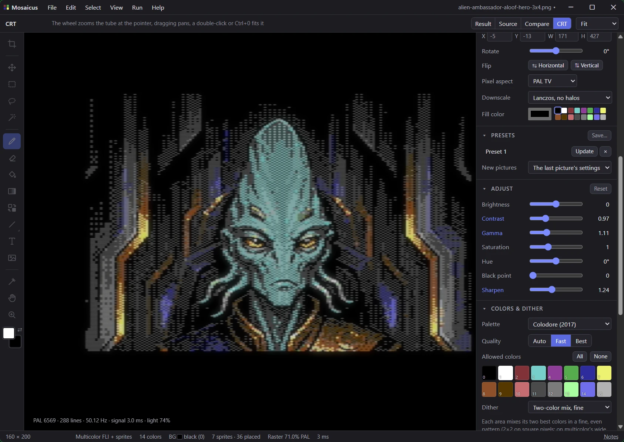
I’ve had a C64 game in development for a while, along with several other game/demo projects, and I’ve required robust image conversion and editing for those. To date, the best image converter I could find is RetroPixels, and none of the editors quite suited my needs. The problem I found with all of them is that they feel like in-house one-offs, with just enough implemented to get someone’s job done, but not polished and not tested, with lots of crashing, etc.

Bolting on filters and plugins for larger image editors is not a great path either, in my opinion. I wanted something built out as a fully polished app, with the Commodore 64 pallet and restrictions at its core, not an afterthought.

So I present to you Mosaicus. MIT license; a Rust app for Windows, MacOS, and Linux. Download and more details at the link. Below I will post a summary of the technical features, but it’s fully documented with an extensive help file here.

I welcome feedback, especially if you a C64 artist and you are missing something in Mosaicus that you’d like to have. I am open to adding more editing features if there is interest.

Continue reading →
Transwarp Writer (Native C64 encoder)

Having always been fascinated by fastloaders, I was mightily impressed when Krill released his Transwarp 50x fast loader that doesn’t require any hardware modifications or custom KERNALs.

It was quite an achievement, with one caveat: it required using a PC tool (cc1541) to encode files in Transwarp format. You couldn’t actually make Transwarp-encoded files on original hardware.

Not any more. Since I’ve always had an interest in speedloaders and Commodore 1541 drive loads in general, I decided it was time to get deep into it. And thanks to Claude Code, I was able to do this without devoting a month of midnight oil to it.

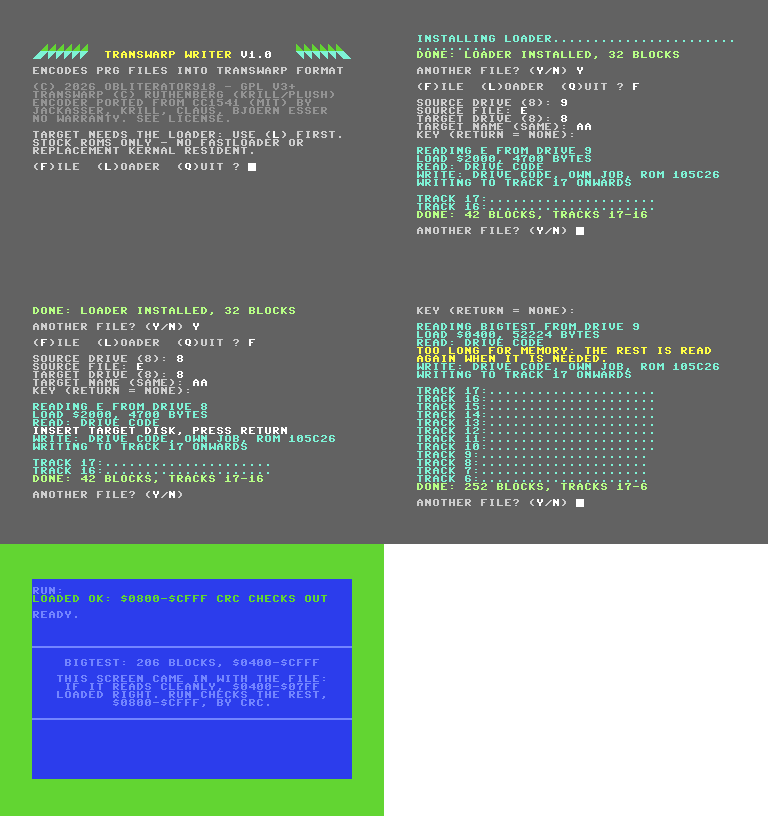
So here’s a Commodore 64, native 6502 Transwarp Writer:

Continue reading →

Microsoft releases 6502 BASIC as open source

Well, this is a nice development.

Without this BASIC the Commodore 64 would never have been anything other than a games console with an above-average keyboard. It opened up computer programming, not just entertainment, to millions of kids at super-low cost. It certainly doesn’t represent modern coding “best practices,” but it represents something kind of lost today: that READY. prompt just waiting for you to give it some instructions, instead of demanding something from you every time you log in.

Galactic Rasterbar Power

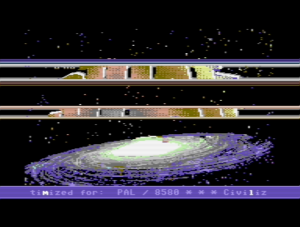
Today I am releasing a new C64 Demo: Galactic Rasterbar Power.

PRG file: Galactic Rasterbar Power.prg
Music only: Phosphor Advance.sid

screen shot

Galactic Rasterbar Power screen shot

I coded this demo in my spare time to accomplish a few goals:

  • Broaden my understanding of 6502/6510 assembly and the C64 memory map
  • Learn more about the VIC-II and how it works along with the CPU
  • Create some interesting multicolor bitmap graphics for my C64
  • Master the raster bar demo effect that I have always really enjoyed
    • And by extension, understand and implement cycle-exact code
  • Make a demo that works equally well on PAL and NTSC hardware.
  • Write some music for the SID chip, and make it work on both major revisions of the SID
  • As a bonus: make the raster bar effect look absolutely perfect in VICE debug borders.

Continue reading →

And 30 years later, I coded up an intro…

30 years (ish) ago, I got my first computer: a Commodore 64.

I learned to program with it. But I stuck with BASIC while I had the C64. I always wanted to learn assembler and write super-fast and fancy games, but I just never did. I didn’t have a monitor cartridge or even know what books to use.

Anyway, I decided that late is better than never. And since OVGE is coming up in less than two months, I decided to make an “OVGE Intro” on my C64.

You can download the prg file here: ovge 2013.prg. Hopefully you have real NTSC Commodore hardware you can run it on. If not, load it up in VICE, and be sure to set the video emulation to NTSC (it defaults to PAL). Update! I did a proper PAL fix, so it will run on NTSC or PAL machines just fine! (I also corrected the music attribution; I had text from previous song I did not use.)

It’s by no means a modern-quality demo, but it has some effects I always wanted to achieve way back in the day.

Developing for the C64 today is so much easier than it was in the 80s. Using cross-development tools, all of the work was done on my Windows PC (I just used Notepad++ to write the assembler code and ACME to build it) and testing was done in VICE. Of course, I put it on a real C64 for viewing the best results.

Here is a quick capture I did and uploaded to YouTube. Unfortunatly, it is not smooth in this video, though it runs perfectly on the real thing.