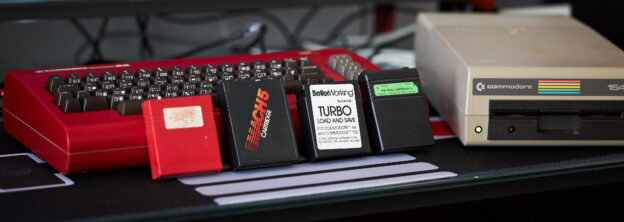
I’ve picked up a few more utility cartridges over the last year and finally got around to playing with them. Using CBM Disk Transfer Benchmark, I’ve compiled transfer rate comparisons for the Mach 5, Better Working Turbo, KCS Power Cartridge, and Final Cartridge III.
I decided it made sense to have a dedicated page for this data, so I’ve put all of my speed loader benchmark data on a dedicated page. It includes tables and graphs.
As for today’s additions, they are all cartridge-based fast load systems from utility cartridges. This table shows all of the cartridge-based fast loaders I’ve measured to date.
| System | Load Bytes per Second | Load Time | DTB Load Score |
| 1541 baseline | 403 | 01:51.5 | 1x |
| KCS Power | 1303 | 00:34.5 | 3x |
| Better Working TURBO | 2101 | 00:21.4 | 5x |
| Epyx Fastload | 2121 | 00:21.2 | 5x |
| Mach 5 | 2121 | 00:21.2 | 5x |
| Warp Speed | 3017 | 00:14.9 | 8x |
| Final Cartridge III | 3406 | 00:13.2 | 9x |
| Super Snapshot 5 | 4163 | 00:10.8 | 10x |
| Action Replay 5 | 5352 | 00:08.4 | 13x |
| Retro Replay | 5352 | 00:08.4 | 13x |
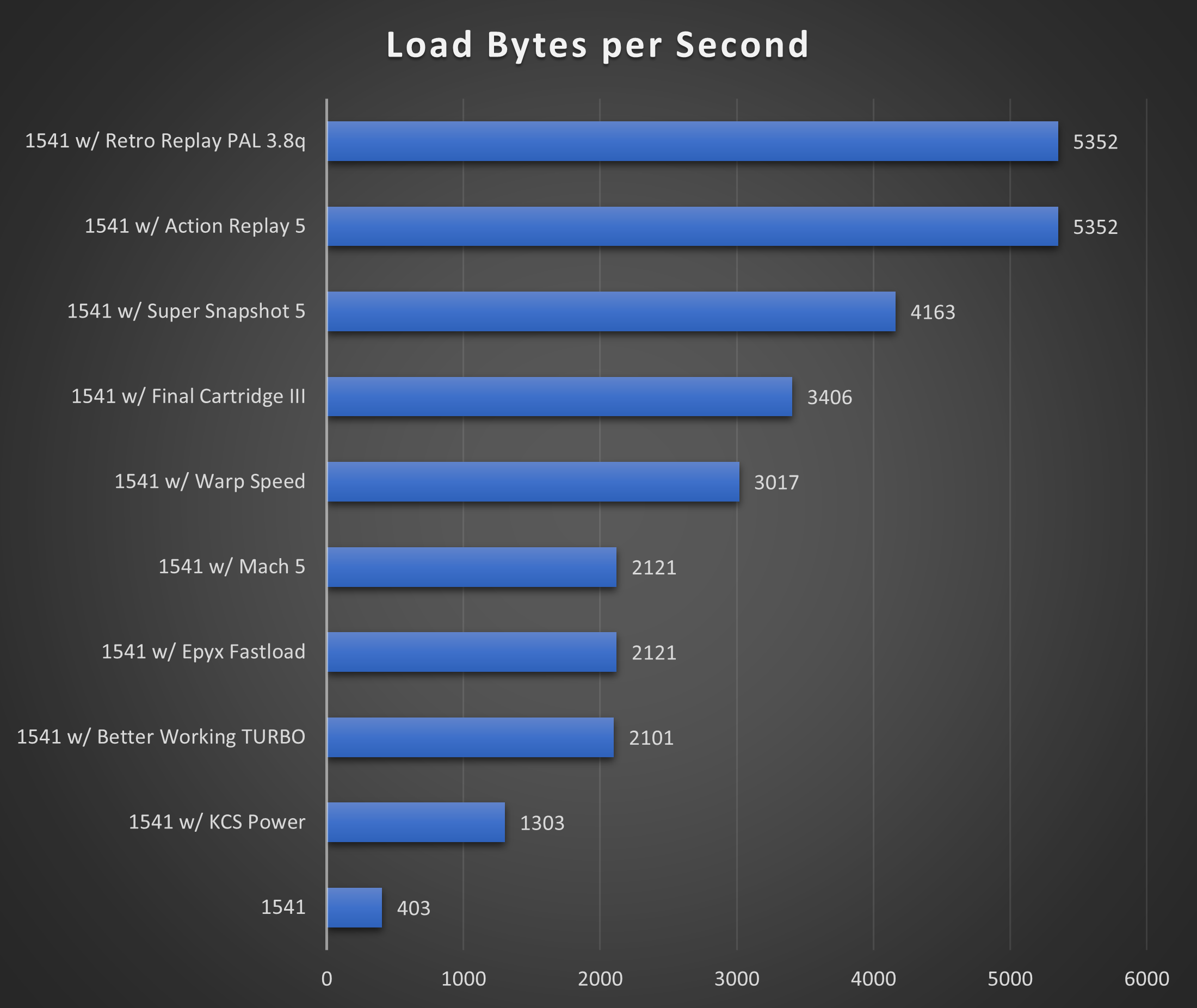
Baseline 1541 load rate compared to CARTRIDGE-BASED fast loaders.
You can see save speeds and how these fit in with the rest here.
Thanks a lot for your fastloader benchmark page – quite useful
I wonder if you – for completeness – could include benchmarking for the SpeedDOS parallel solution ?
In northern Europe it was the first real non-cartridge fastloader that gained succes – it is definitely not as fast as DolphinDOS – but I guess that SpeedDOS have inspired DolphinDOS and others
Thanks in advance
Kind regards
Uffe (Microtop/Starion)
Hy. I’m not entirely sure, one should rely solely on this benchmark tool. I’ve experimented with this program a bit and there are certain fastloaders that simply can’t be tested with it, for example those, that unload themselves from memory, after loading a file (in this case, the benchmark program itself). Since they disappear from memory, when the tool is loaded and then, of course, they can no longer be tested, inside the tool, because they are gone.
Also, regarding some of the loaders I tested, I got slightly different results when timing the loading processes myself, compared to, what the benchmark tool reported. So, while it’s certainly useful as a supplementary tool, you can’t rely on it exclusively. It always makes sense, to manually load the same large onefiler from a disk, using different loaders and time the process yourself. Sure, such measurements won’t be accurate to the hundredth of a second, but you can definitely get them accurate to the second. You can always use the benchmark tool alongside your own tests and post both sets of results. Then this can be compared and a conclusion drawn, from both results. In my eyes, this makes the most sense.