SuperCPU format
Multicolor, background per 4 × 1 is a multicolor (Koala) picture with one rule loosened: the background is no longer one color for the whole picture. Each 4 × 1 cell (4 wide pixels, one line) has a background of its own. It needs a C64 with a SuperCPU at 20 MHz: its program rewrites the background color 40 times on every line.
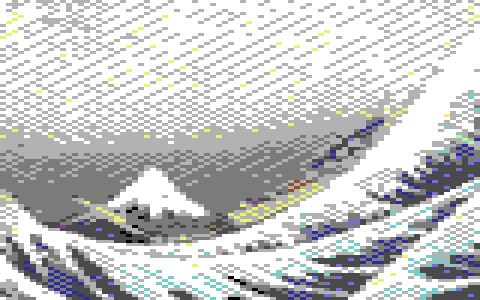
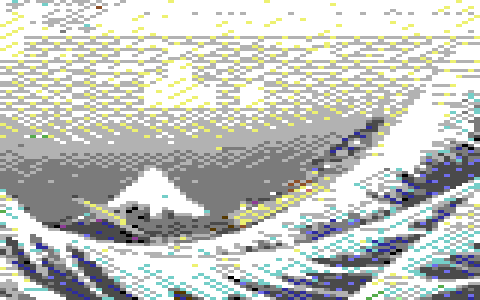
The Great Wave, both at Quality Best, a detail at 3×.
The rules
160 × 200 wide pixels. Each 4 × 8 cell has three colors of its own, as in a Koala picture, and each 4 × 1 line of it has a background of its own as well. So a cell can show up to three colors plus a different background on every line.
The exception is each character row's first line (its badline, where the C64's video chip takes the bus from the processor): there, the whole line across the picture has one background.
The picture sits one hires pixel right of where a Koala picture sits: the screen's first hires column shows each line's first background, and the right half of the last wide pixel is under the border.
How much it gains depends on the picture. The gain is largest on pictures with many colors in each cell, such as cartoons and high-contrast art; in many photos the C64's 16 colors, not the cells, are what limits the picture, and it looks much like a Koala.
The Format panel's options
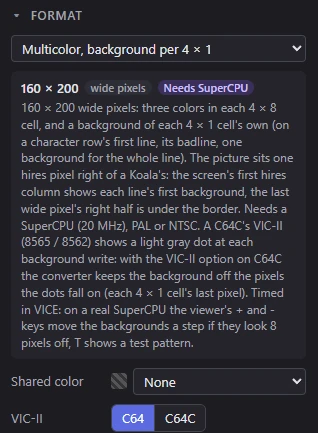
- Shared color (default None): a color every 4 × 8 cell has (the color RAM filled with one color). Each cell then picks only two colors of its own, besides its lines' backgrounds. Usually leave it off.
- VIC-II: the video chip the picture is made for.
- C64 (the default): the original C64's VIC-II (6569 PAL, 6567 NTSC).
- C64C: the later C64C's VIC-II (8565 PAL, 8562 NTSC). This chip shows a light gray dot, one hires pixel wide, each time the background color is written, wherever that pixel shows the background: on each 4 × 1 cell's last pixel, and in the picture's first column. With C64C, the converter keeps the background off those pixels (they take one of the cell's three colors instead), so the picture shows no dots but the first column's, and the preview shows the dots that remain.
There is no Background option: the backgrounds are chosen line by line.
The Colors & dither panel's Quality row works as for the standard formats: Best is clearly better, and takes about a second.
Running it
- Run ▸ In VICE (F5) runs it in VICE's SuperCPU emulator, xscpu64. Run ▸ On C64 Ultimate is off for this format: the Ultimate has no SuperCPU.
- On a C64, load and run the exported program (about 26 KB) on a SuperCPU set to Turbo (20 MHz), PAL or NTSC.
The program checks what it runs on. Without a SuperCPU it prints THIS PICTURE NEEDS A SUPERCPU., and with the SuperCPU's speed switch at Normal (1 MHz) it says to set it to Turbo; either way it returns to BASIC.
The + , - and T keys
The program's timing was measured in VICE. A real SuperCPU may start each line a moment earlier or later, which moves every background 8 pixels sideways. So while the picture shows, the program reads the keyboard:
| Key | Does |
|---|---|
| + | Moves every background one step (8 pixels) right. |
| - | Moves every background one step (8 pixels) left. |
| T | Shows a test pattern; T again goes back to the picture. |
+ and - go up to 4 steps either way. The test pattern is 8-pixel columns, white and blue in turn: when the timing is right each column is one plain color; when it is a step off, each column has thin stripes of the other color. Press + or - until the columns are plain, then T for the picture. The program starts at the timing measured in VICE.
What it exports as
- SuperCPU multicolor data (
.bin, 18,000 bytes): the bitmap (a Koala's layout), the screen, the color RAM, then each line's 40 backgrounds, line by line (a badline's 40 all its one color). - Assembly source, PNG, the C64 program and its viewer source.
There are no paint program files for this format: no other program shows it.
Related pages
- Standard formats: the plain Koala picture this format builds on.
- Running on a C64: VICE and xscpu64.
- C64 Ultimate formats: the other accelerated formats.